

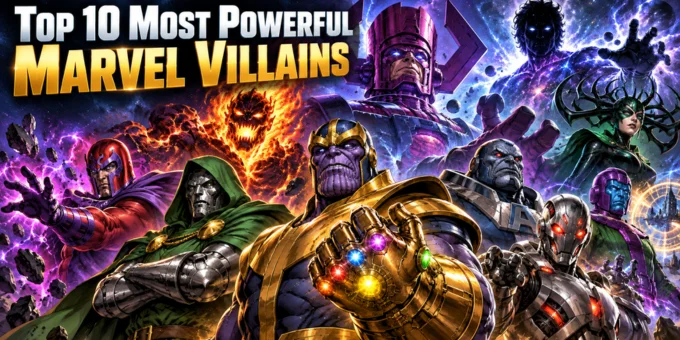
Marvel Comics has created threats ranging from brilliant dictators to reality-reshaping beings. The top 10 most powerful Marvel villains therefore cannot be ranked through physical strength alone. This list weighs cosmic scale, durability, magic, reality manipulation, major feats, and meaningful weaknesses.
Direct answer: The Beyonder takes our number-one spot because his greatest comic appearances place him beyond most conventional cosmic threats. The One Below All follows because its destructive reach extends far beyond ordinary battles. Knull, Dormammu, Galactus, Mephisto, Thanos, Doctor Doom, Onslaught, and Annihilus round out the list.
Quick Ranking at a Glance
| Rank | Villain | Primary Power Edge | Major Limitation |
|---|---|---|---|
| 1 | The Beyonder | Reality manipulation on an immense scale | Power level varies by continuity. |
| 2 | The One Below All | Cosmic destruction and corruption | Functions more like a cosmic force |
| 3 | Knull | Symbiote control and god-level combat ability | Can be separated from his advantages |
| 4 | Dormammu | Dimensional magic and reality control | Strongest within his own domain |
| 5 | Galactus | Power Cosmic and planetary-scale energy | Hunger can weaken him. |
| 6 | Mephisto | Magic, soul manipulation, reality distortion | Power changes outside his realm. |
| 7 | Thanos | Strength, durability, intellect, cosmic knowledge | Greatest upgrades often rely on artifacts. |
| 8 | Doctor Doom | Science, sorcery, strategy, power theft | The baseline form lacks cosmic-level raw power |
| 9 | Onslaught | Telepathy, telekinesis, and psionic power | Unstable nature creates vulnerabilities. |
| 10 | Annihilus | Cosmic Control Rod and massive armies | Equipment contributes heavily to his threat. |
Key Takeaways
- The ranking focuses primarily on mainstream comic-book portrayals rather than MCU versions.
- Standard abilities matter more than brief transformations or borrowed artifacts.
- Reality manipulation ranks above straightforward physical strength.
- Intelligence and preparation can let weaker characters defeat stronger opponents.
- Several characters shift between villain, antagonist, and cosmic force depending on the story.
How We Ranked the Top 10 Most Powerful Marvel Villains
Marvel does not publish one permanent power chart covering every antagonist. Character strength also changes because different writers use different versions and circumstances. Recent rankings likewise acknowledge that comparing cosmic entities with conventional supervillains requires editorial judgment.
This ranking weighs demonstrated scale, versatility, durability, and independent power most heavily. Temporary upgrades still count as evidence of potential, but they do not completely define a character. That distinction matters greatly for figures such as Thanos and Doctor Doom.
A character also ranks higher when several abilities remain dangerous across different situations. Reality alteration, magic, cosmic energy, telepathy, and dimensional control can matter more than muscle. Weaknesses and dependence on artifacts can push an otherwise devastating antagonist lower.
10. Annihilus
Annihilus is one of Marvel’s most dangerous large-scale conquerors, especially during stories involving the Negative Zone. His Cosmic Control Rod enhances his abilities and helps extend his already unusual lifespan. His armies can turn his personal power into an interstellar crisis.
The Annihilation storyline demonstrated why defeating him requires more than winning a normal superhuman fight. He can command overwhelming forces while pursuing destruction across enormous distances. That combination puts him above many stronger individual fighters.
His main weakness is dependence on resources beyond his natural physical abilities. Taking away technology or armies makes the threat easier to contain. That limitation keeps him below Marvel’s strongest cosmic beings.
9. Onslaught
Onslaught emerged from the combined psychic darkness associated with Professor X and Magneto. That origin gave the entity extraordinary telepathic and telekinetic abilities. Later developments expanded its power until major hero teams faced a catastrophic threat. Raw physical strength becomes less useful against an opponent that attacks minds and manipulates energy.
Onslaught can threaten powerful characters before a traditional fight even starts. That versatility is why the entity ranks above many conventional supervillains. Its strange origin also creates instability that stronger cosmic beings do not share. Onslaught has repeatedly depended on particular circumstances and hosts. Those weaknesses make its power harder to sustain consistently.
8. Doctor Doom
Victor von Doom is dangerous because he combines scientific genius with great magical skill. Few opponents can prepare for both technological and mystical attacks at once. Marvel has even called Doom arguably one of the world’s deadliest villains. His greatest feats become far more dramatic when he obtains outside cosmic power. During Secret Wars, Doom helped defeat the Beyonders and gained power used to construct Battleworld.
Marvel’s own history of that event makes clear that this was an extraordinary upgrade, not his normal state. That distinction explains his position here. Baseline Doom lacks the natural cosmic output of several higher-ranked characters. Given preparation and access to the right power source, though, he can become more dangerous than almost anyone.
Fans following Marvel actors may also recognize Arian Moayed from Spider-Man: No Way Home. Mindspaper’s Arian Moayed movie guide covers his appearance as Agent Cleary. His MCU role offers another route into Marvel’s expanding screen universe.
7. Thanos
Thanos has enormous natural strength, durability, intelligence, and experience even without the Infinity Gauntlet. Marvel describes him as a cosmic overlord whose enemies include heroes across its universe. He has also defeated powerful cosmic opponents. The Infinity Gauntlet raises him to a completely different level, but that power comes from external objects. Ranking only that version would make artifact ownership more important than the character’s usual abilities.
This list therefore treats the Gauntlet as a peak feat rather than his baseline. Thanos still ranks comfortably among Marvel’s most dangerous recurring antagonists without it. His combination of strength and strategy can overwhelm teams built to stop global threats. His obsession with greater power also repeatedly creates both his greatest victories and his eventual defeats.
6. Mephisto
Mephisto rarely needs to overpower enemies through punches because his abilities work on more dangerous levels. He uses magic, deception, soul manipulation, and reality distortion. Fighting him can therefore involve psychological or supernatural stakes rather than physical survival alone.
His power becomes especially formidable when stories enter domains tied directly to him. He can manipulate environments and bargains while exploiting a target’s desires. That makes straightforward combat a poor answer to his schemes.
The main qualification is that his effectiveness changes with location and story conditions. Marvel’s mystical hierarchy also contains forces beyond his reach. Those restrictions keep him outside the top five.
5. Galactus
Galactus operates on a scale that makes most Earth-based threats look small. His hunger drives him to consume worlds’ energy. The Power Cosmic also gives him abilities extending far beyond superhuman strength. Marvel stories have repeatedly treated confronting him as a crisis for entire civilizations. Even Doctor Doom’s encounters with Galactus often involve attempts to steal or manipulate cosmic power.
Marvel’s Secret Wars material specifically depicts Doom seeking Galactus’s enormous energy. Hunger remains an important limitation because his condition affects his available strength. He isn’t a simple villain in every appearance. Still, his destructive potential comfortably earns him a top-five position.
Readers who enjoy large-scale science-fiction threats can also explore Mindspaper’s guide to The Tomorrow War 2. Its discussion of alien invasions and future warfare offers a different kind of world-level menace. Cosmic comics push that threat scale much farther.
4. Dormammu
Dormammu rules the Dark Dimension and possesses immense mystical abilities. Marvel repeatedly presents beings from his family as extraordinarily powerful magical entities. His sister Umar, for example, is described by Marvel as a being of pure magical energy. Within his dimensional territory, Dormammu becomes especially difficult to challenge. He can manipulate energy, magic, and reality on scales that overwhelm ordinary sorcerers.
Doctor Strange often survives these encounters through intelligence or special circumstances rather than superior force. His greatest advantage can also become a ranking limitation. Dormammu’s dominance is closely connected to dimensional conditions. The three characters above him demonstrate similarly enormous power with fewer situational restrictions.
3. Knull
Knull is the dark god associated with the origin of Marvel’s symbiotes. His control over symbiote forces gives him both personal strength and an enormous arsenal. That combination reached devastating levels during King in Black. Marvel’s own coverage positioned Celestials among the few beings capable of resisting his attack. That is a significant indicator of his threat level.
It places him far beyond antagonists whose greatest challenge is defeating one hero team. Knull also benefits from unusual offensive options, including symbiote control and powerful constructed weapons. His abilities can threaten gods as well as ordinary beings. Only Marvel’s most extreme reality-level entities rank above him here.
2. The One Below All
The One Below All represents destruction on a scale that is hard to compare to ordinary characters. It is tied closely to Marvel’s deepest cosmic mythology and destructive forces. Treating it as a conventional fighter misses why it is so dangerous. Its threat can reach across existence rather than target one city, planet, or hero. That puts it beyond opponents whose power remains tied to energy blasts or physical combat.
Recent comics-focused rankings also place the entity near the highest tier of Marvel antagonists. The biggest complication is classification. The One Below All behaves more like a fundamental destructive presence than a traditional costumed villain. It still belongs here because its antagonistic role and scale fit the question readers are trying to answer.
1. The Beyonder
The Beyonder earns first place because his original comic portrayal operated beyond nearly every normal measure of superhuman power. Reality manipulation matters more than strength when an entity can change the rules surrounding a battle. That distinction makes conventional comparisons almost meaningless.
Secret Wars also established how valuable the Beyonder’s power was to Doctor Doom. Doom’s theft of extraordinary power became one of Marvel’s defining examples of a villain reaching godlike status. Later stories changed aspects of Beyonder mythology, which makes any fixed ranking debatable.
For this list, the original scale remains enough to secure first place. His placement does not mean every later incarnation automatically defeats every character. It means his strongest established portrayal creates the highest baseline for this particular ranking.
Power Comparison: Where Each Villain Has the Advantage
| Villain | Biggest Advantage | Biggest Weakness |
|---|---|---|
| The Beyonder | Reality alteration | Continuity changes |
| The One Below All | Cosmic destruction | Abstract nature |
| Knull | Symbiote domination | Can lose control advantages |
| Dormammu | Dimensional magic | Location matters |
| Galactus | Cosmic energy | Hunger |
| Mephisto | Souls and magic | Realm dependence |
| Thanos | Strength and strategy | Artifact reliance at peak power |
| Doctor Doom | Preparation and versatility | Lower baseline raw power |
| Onslaught | Psychic abilities | Instability |
| Annihilus | Armies and technology | Equipment dependence |
Is Doctor Doom Stronger Than Thanos?
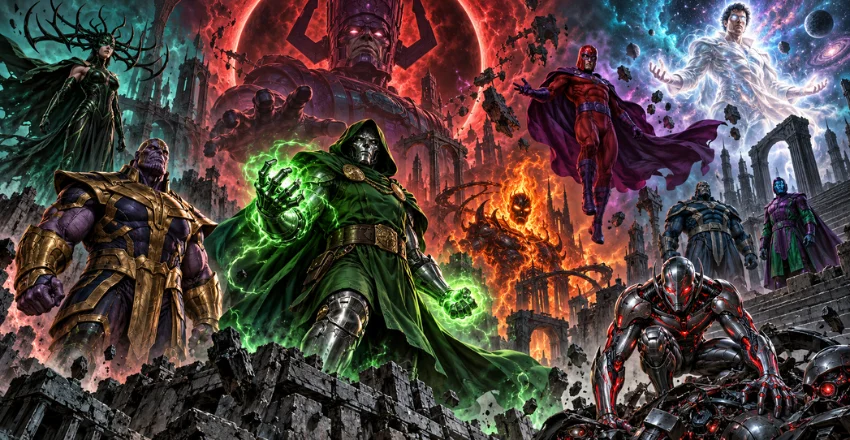
In a straightforward baseline fight, Thanos has the clearer raw-power advantage. Doom’s armor, magic, and intelligence make him dangerous, but Thanos is naturally stronger. A current 2026 comparison reaches a similar conclusion while emphasizing Doom’s superior opportunities for manipulation.
Special circumstances can reverse that answer completely. God Emperor Doom famously possessed power far beyond his normal level during Secret Wars. That version could overwhelm opponents who would normally have the physical advantage.
The comparison shows why power rankings need clearly stated rules. Using every temporary transformation produces a different list from comparing standard forms. Our ranking rewards repeatable power while still recognizing exceptional accomplishments.
Does the MCU Ranking Look Different?
Yes, an MCU-only list would look substantially different because several comic versions have not appeared on screen. Film and television adaptations can also change abilities, origins, and limitations. Mixing those versions creates comparisons that look precise but use incompatible evidence.
Thanos is a good example because the Infinity Stones define much of his best-known MCU threat. Comic stories give him a longer history of cosmic achievements and different relationships. Doctor Doom’s screen importance is also changing as Marvel Studios expands its next major storyline.
For more Mindspaper entertainment coverage, the site’s Victor Buono movie retrospective looks at another famous screen villain performer. Buono’s King Tut came from DC’s Batman, not Marvel. His career shows how memorable villains have shaped superhero entertainment across generations.
Final Verdict
The Beyonder is our strongest pick because reality control can supersede almost every conventional combat advantage. The One Below All and Knull follow because their threats extend to cosmic and multiversal stakes. Dormammu and Galactus complete a top five dominated by beings operating far beyond ordinary Earth conflicts.
Thanos and Doom remain more recognizable to many readers, but recognition does not equal raw power. Both can reach higher positions when artifacts or temporary transformations are included. Their intelligence also makes them dangerous enough to defeat opponents who outrank them.
The ranking is intentionally comics-focused and uses standard abilities as its foundation. Different writers can always create circumstances that change a particular fight. That uncertainty is part of what keeps Marvel power debates interesting.
Frequently Asked Questions
Who are the top 10 most powerful Marvel villains?
This ranking places the Beyonder first, followed by the One Below All, Knull, Dormammu, and Galactus. Mephisto, Thanos, Doctor Doom, Onslaught, and Annihilus fill the remaining positions. The order prioritizes repeatable comic-book abilities over temporary artifacts.
Who is the strongest Marvel villain?
The Beyonder is our choice when his original portrayal is considered. His reality-altering power places him beyond most standard cosmic threats. Later continuity changes could reasonably lead to a different ranking.
Is Galactus stronger than Thanos?
Galactus generally has the larger natural cosmic power set under standard conditions. Thanos can exceed him when using extraordinary artifacts or special upgrades. The answer changes if the comparison includes the Infinity Gauntlet.
Why isn’t Doctor Doom ranked higher?
Doom’s greatest strength is his ability to prepare, manipulate, and acquire more power. His normal form lacks the raw cosmic output of entities such as Galactus or Dormammu. Temporary forms like God Emperor Doom would rank dramatically higher.
Is Knull stronger than Thanos?
Knull has advantages tied to symbiote control, god-level combat, and large-scale conquest. Baseline Thanos brings greater strategic experience and exceptional durability. Their exact result would depend heavily on the setting, resources, and the versions being compared.