


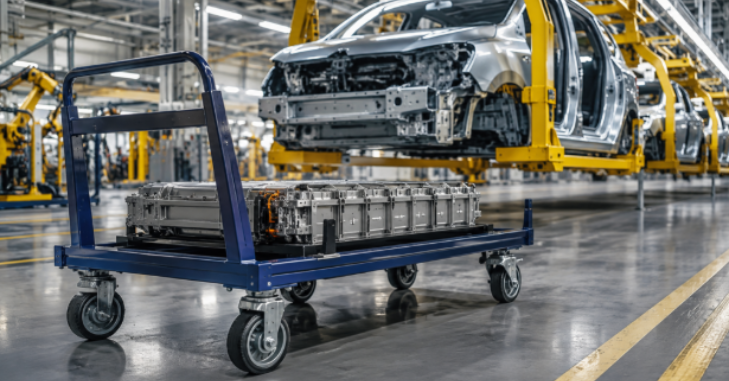
In automotive manufacturing environments, even small inefficiencies in material movement can lead to significant production delays. Assembly lines, sub-assembly stations, and logistics zones all depend on mobile equipment—racks, carts, engine stands, tool trolleys, and transport platforms—that must move smoothly and reliably. One often overlooked but critical component influencing this flow is the wheel system used beneath this equipment. Poor selection of casters and swivel casters can quietly increase downtime, reduce productivity, and create safety risks that compound over time.
Reducing downtime is not only about large investments in robotics or software systems; it is also about optimizing small mechanical components that support daily operations. Wheel assemblies, though simple in appearance, directly affect how quickly materials move between stations, how easily workers handle loads, and how frequently equipment requires maintenance or replacement.
Why Mobility Systems Matter in Automotive Plants
Automotive plants are highly synchronized environments. Every workstation depends on a precise flow of parts—engines, transmissions, chassis components, electronic modules, and body panels. If one section slows down, the ripple effect can disrupt the entire production line.
Mobile equipment plays a key role in maintaining this flow. For example:
- Parts carts transport components between storage and assembly stations
- Tool carts ensure technicians have immediate access to equipment
- Heavy-duty racks move subassemblies across different production zones
- Maintenance trolleys support quick repair and servicing tasks
Each of these systems relies on wheels that must withstand heavy loads, frequent movement, and sometimes harsh floor conditions. When these mobility systems fail or underperform, downtime occurs in multiple forms: equipment becomes harder to move, operators take longer to complete tasks, or components require frequent repairs.
The Direct Link Between Wheel Performance and Downtime
Downtime in automotive plants is often associated with major equipment failure, but minor inefficiencies accumulate just as significantly. Poorly chosen wheel systems can lead to:
- Increased push/pull force requirements
- Reduced maneuverability in tight production spaces
- Higher wear and tear on carts and racks
- Frequent replacement cycles
- Floor damage requiring maintenance interruptions
These issues might not stop production immediately, but they slow down workflow continuously. Over time, these delays translate into measurable losses in output.
For instance, if a parts cart requires extra effort to maneuver due to high rolling resistance, a technician may take longer to complete each transport cycle. Multiplied across hundreds of daily movements, this becomes a significant productivity bottleneck.
Key Factors That Influence Downtime Reduction
1. Load Capacity and Overengineering Balance
One of the most important considerations is load capacity. Automotive components can be extremely heavy, especially in engine assembly or EV battery production environments. Selecting wheels with insufficient load ratings leads to deformation, failure, or unsafe operating conditions.
However, overengineering also introduces trade-offs. Extremely high-capacity wheels often have harder materials and larger sizes, which can increase rolling resistance and reduce maneuverability. This creates a paradox: stronger equipment may be harder to move, indirectly increasing operator fatigue and slowing workflow.
The optimal solution lies in balancing load requirements with mobility efficiency rather than simply choosing the highest-rated option available.
2. Floor Conditions and Rolling Resistance
Automotive plants typically use polished concrete floors, epoxy coatings, or sealed industrial surfaces. While these floors appear smooth, they may include expansion joints, debris, or slight unevenness that affects movement.
Wheel material selection becomes critical here. Softer materials improve grip and shock absorption but wear faster, leading to frequent replacements. Harder materials last longer but may transmit vibration, affecting both equipment stability and operator comfort.
Rolling resistance directly impacts downtime because higher resistance increases the time required for each movement cycle and accelerates fatigue-related inefficiencies among workers.
3. Maneuverability in Tight Production Spaces
Automotive facilities are often densely packed with machinery, conveyors, and workstations. Navigation through these spaces requires high maneuverability.
Swivel mechanisms allow multidirectional movement, making them essential in confined environments. However, fully rotational systems can sometimes reduce stability under heavy loads. In contrast, fixed-direction wheels provide stability but limit flexibility.
A mixed configuration—balancing directional control and rotation—often provides the best compromise, but it requires careful planning based on workflow design.
4. Maintenance Requirements and Lifecycle Costs
Downtime is not only caused by operational inefficiency but also by maintenance interruptions. Wheel assemblies that wear out quickly require frequent replacement, leading to unplanned stoppages.
Factors influencing maintenance frequency include:
- Bearing quality
- Material durability
- Exposure to chemicals or oils in manufacturing environments
- Frequency of load impact
High-quality components may have higher upfront costs, but they significantly reduce long-term maintenance requirements. Conversely, lower-cost options may save money initially but increase downtime due to frequent replacements.
5. Ergonomics and Operator Fatigue
Operator fatigue is a major but often underestimated contributor to downtime. If equipment is difficult to move, workers slow down or require additional assistance. Over time, this reduces overall throughput.
Ergonomically optimized wheel systems reduce required force, improving speed and reducing physical strain. This also contributes to workplace safety, as fewer injuries lead to fewer unplanned stoppages.
However, ergonomic designs often involve softer materials or more complex mechanisms, which may require more frequent inspection or replacement.
Trade-Offs in Selecting Mobility Systems
Improving downtime through better wheel selection is not a straightforward optimization problem. It involves balancing competing priorities:
- Durability vs. maneuverability
- Load capacity vs. rolling efficiency
- Cost vs. lifecycle performance
- Stability vs. flexibility
For example, a high-durability wheel may reduce maintenance frequency but increase resistance, slowing movement. Similarly, highly flexible configurations improve navigation but may introduce instability under heavy loads.
Automotive plants must therefore evaluate not just individual component performance but how those components interact within the broader production system.
Application-Specific Considerations in Automotive Plants
Different areas within an automotive facility have distinct mobility requirements.
Assembly Lines
In assembly environments, smooth and predictable movement is essential. Equipment must travel in straight paths with minimal resistance. Stability and load-bearing capacity are prioritized over extreme maneuverability.
Parts Warehousing
Warehouse environments require frequent directional changes and navigation through narrow aisles. Here, flexibility becomes more important than rigidity, and wheel responsiveness directly affects picking and transport efficiency.
Maintenance Zones
Maintenance carts require high mobility and quick repositioning. Downtime here is often related to response time, so ease of movement is critical.
Paint and Finishing Areas
These environments often involve chemical exposure and strict cleanliness requirements. Wheel materials must resist corrosion and contamination while maintaining smooth motion.
Each application requires a different balance of performance characteristics, reinforcing the need for tailored selection rather than a universal solution.
Challenges in Standardizing Wheel Systems
One common challenge in automotive plants is the attempt to standardize mobility systems across all departments. While standardization simplifies procurement and maintenance, it may not align with operational diversity.
A single wheel type may perform well in one area but poorly in another. For example, a wheel optimized for heavy engine transport may be too rigid for lightweight tool carts, reducing efficiency in those areas.
This creates a dilemma between operational consistency and performance optimization. Plants must carefully evaluate whether standardization supports or hinders overall productivity.
The Impact of Small Inefficiencies Over Time
Downtime is often viewed as a result of major failures, but in reality, it is frequently the accumulation of small inefficiencies. Slight increases in rolling resistance, minor delays in maneuvering, or repeated maintenance interruptions collectively reduce output.
When multiplied across hundreds of carts and thousands of daily movements, even a one- or two-second delay per operation can translate into hours of lost productivity each week.
This is why wheel selection should be treated as a strategic operational decision rather than a minor procurement detail.
Wrapping Up
Reducing downtime in automotive manufacturing requires a holistic approach to equipment mobility. Wheel systems play a far more significant role than they are often given credit for, influencing everything from operator efficiency to maintenance cycles and workflow continuity.
The selection of appropriate wheel assemblies involves balancing durability, load capacity, maneuverability, and ergonomics. Each decision comes with trade-offs, and no single configuration is universally optimal across all production environments.
By carefully analyzing operational requirements and understanding how mobility systems influence workflow, automotive plants can significantly reduce inefficiencies and improve overall productivity. In many cases, the difference between smooth operation and recurring delays is not a major infrastructure upgrade, but the thoughtful selection of the components beneath the equipment that keeps production moving.