


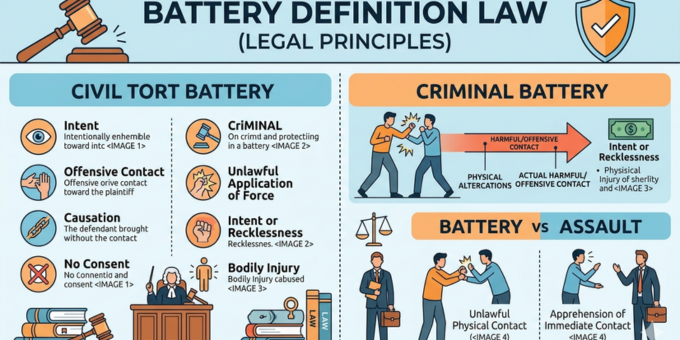
In common parlance, “battery” usually refers to the power source inside our electronics. However, in the hallowed halls of justice, the term takes on a much more serious, physical meaning. Understanding the Battery Definition Law is crucial for anyone navigating the complexities of personal injury (torts) or criminal justice. For a closer look, see The Ultimate Guide to Exculpatory Meaning.
While often confused with assault, battery is its own distinct legal entity centered on the concept of unconsented physical contact. Key elements typically include Intent, harmful or offensive touching, and lack of consent, each of which must be proven to attach liability.
Penalties and remedies vary widely—criminal charges can lead to fines or imprisonment, while civil claims may result in compensatory damages for medical costs and emotional distress. Because statutes and case law differ by jurisdiction, consulting a qualified attorney promptly is essential to protect your rights and assess possible defenses.
| Category | Aspect | Explanation | Example |
| Meaning | Legal Definition | Intentional and harmful or offensive physical contact without consent | Punching or pushing someone |
| Purpose | Protects bodily integrity and personal dignity | Preventing unwanted physical interaction | |
| Legal Elements | Intent | Deliberate action to make contact | Throwing an object at someone |
| Contact | Physical interaction (direct or indirect) | Hitting or spitting | |
| Harm/Offense | Injury or offensive touching | Slapping someone | |
| Lack of Consent | The victim gave no permission | Unwanted touching | |
| Causation | Direct link between act and contact | Causing someone to fall intentionally | |
| Types of Battery | Simple Battery | Minor harmful or offensive contact | Pushing during an argument |
| Aggravated Battery | Serious injury or use of a weapon | Attacking with a knife | |
| Sexual Battery | Non-consensual sexual contact | Unwanted intimate touching | |
| Domestic Battery | Occurs within family or intimate relationships | Spousal violence | |
| Civil Battery | Lawsuit for compensation rather than punishment | Suing for damages after an incident | |
| Case Examples | Indirect Contact | Contact caused without direct touch | Throwing a drink at someone |
| Medical Context | Procedure without patient consent | Unauthorized surgery | |
| Everyday Scenario | Common real-life incident | Pulling a chair causes someone to fall | |
| Defenses | Consent | The victim agreed to the contact | Contact in sports |
| Self-Defense | Reasonable force to protect oneself | Blocking and pushing the attacker | |
| Defense of Others | Protecting another person | Intervening in a fight | |
| Necessity | Action taken to prevent greater harm | Moving someone forcefully out of danger | |
| Consequences | Criminal Penalties | Legal punishment by the state | Fines or imprisonment |
| Civil Liability | Financial compensation to the victim | Paying damages |
What is a Battery Definition Law? The Core Meaning
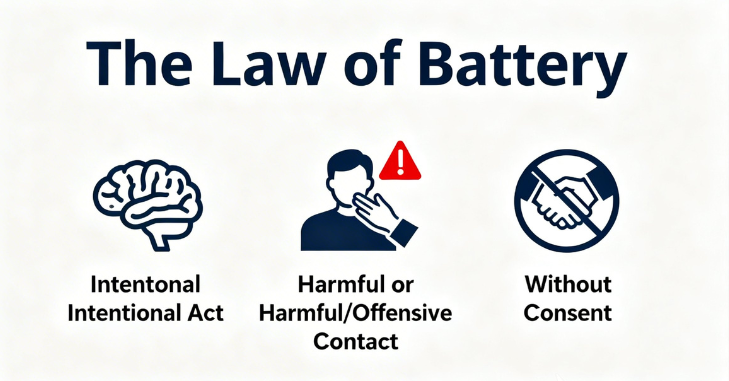
Under the broad umbrella of the Battery Definition Law, battery is defined as the intentional and offensive or harmful touching of another person without their consent. Unlike assault—which is the apprehension or fear of being touched—battery requires that the contact actually occur.
In legal theory, this law exists to protect an individual’s right to personal autonomy and “bodily integrity.” It posits that every person has a “sacred” space around their body, and any unauthorized entry into that space that results in harm or offense is a violation of legal rights.
The Four Essential Legal Elements
For a plaintiff or prosecutor to successfully argue that a violation of the Battery Definition Law has occurred, four specific elements must be proven. If even one element is missing, the case may fail.
- Intent: The defendant must have intended to cause the contact. This does not necessarily mean they intended to cause harm; it only means they intended the physical act itself. For example, if you swing your arm to hit someone but miss and hit a third party, the “transferred intent” doctrine still applies.
- Contact: Actual physical touching is required. This contact does not have to be skin-to-skin; it can involve anything closely attached to the person, such as their clothing, a cane they are holding, or even a bag they are carrying.
- Harmful or Offensive Nature: The contact must be either physically painful (harmful) or a violation of social dignity (offensive). An offensive touch is defined by what a “reasonable person” would find objectionable under the circumstances.
- Lack of Consent: The victim did not consent to the contact. In sports like boxing or football, participants provide “implied consent” to certain types of contact, which negates a claim of battery unless the contact exceeds the rules of the game.
Battery vs. Assault: Key Differences

It is a frequent mistake to use these terms interchangeably. The following table highlights the functional differences between these two legal concepts.
| Feature | Assault | Battery |
| Primary Requirement | Threat or fear of contact. | Actual physical contact. |
| Physical Touch | Not required. | Mandatory. |
| Mental Element | The victim must be aware of the threat. | The victim does not need to be aware (e.g., being hit from behind). |
| Legal Focus | Protection against mental distress/fear. | Protection of physical bodily integrity. |
Common Types of Battery
The Battery Definition Law categorizes incidents based on the severity of the act and the Intent of the perpetrator.
1. Simple Battery
This is the most common form, typically involving minor physical contact that doesn’t result in serious injury but is clearly offensive or unwanted. Examples include a shove during an argument or spitting on someone.
2. Aggravated Battery
This is a more serious charge, usually elevated to a felony. It occurs when the defendant uses a deadly weapon, intends to cause great bodily harm, or targets a protected individual (like a police officer or an older adult).
3. Medical Battery
In the healthcare field, this happens when a doctor performs a procedure without the patient’s informed consent. Even if the surgery is successful and helps the patient, doing it without permission violates the Battery Definition Law.
4. Technical Battery
This refers to a situation in which a person’s space is violated in a technical sense, without significant injury. It often arises in civil lawsuits where the plaintiff seeks to prove that their rights were violated, even if they didn’t require medical attention.
Real-World Case Examples

To see how the Battery Definition Law operates in practice, we can look at several hypothetical and historical scenarios:
- The “Unwanted Kiss” (Offensive Contact): If an individual forcefully kisses another person without permission at a social gathering, this constitutes battery. While no “physical injury” occurred, the act is considered “offensive to a reasonable sense of personal dignity.”
- The Crowded Bar Shove (Lack of Intent): If Person A slips on a spilled drink and accidentally knocks into Person B, this is generally not battery because the element of Intent is missing. It was an accident, not a volitional act.
- Fisher v. Carrousel Motor Hotel, Inc. (Extension of the Person): A famous legal case where a defendant snatched a plate out of a plaintiff’s hand while shouting an insult. The court ruled that because the plate was an extension of the person’s body, the act constituted a violation of the Battery Definition Law.
Defenses Against a Battery Charge

Not every instance of physical contact leads to a conviction or a successful lawsuit. There are several legal “excuses” or justifications:
- Self-Defense: You may use a reasonable amount of force to protect yourself from an imminent threat.
- Defense of Others: Similar to self-defense, you can legally intervene to protect another person from harm.
- Consent: As mentioned, participating in contact sports or certain medical procedures involves giving consent to being touched.
- Privilege: Law enforcement officers have a limited privilege to use force when making a lawful arrest, provided the force is not excessive.
The Significance of the “Reasonable Person” Standard
In interpreting the Battery Definition Law, courts often rely on the “Reasonable Person” standard. This is an objective test used to determine if a touch was truly “offensive.” For example, a gentle tap on the shoulder to get someone’s attention in a crowded hallway is something a reasonable person would expect and find acceptable.
However, a forceful poke in the chest during a heated debate crosses the line into offensive contact. The law does not protect the “unduly sensitive” person; it protects the average citizen from contact that violates standard social norms.
Final Considerations
The Battery Definition Law serves as a vital guardian of our physical boundaries. Whether it is a minor shove or a serious physical altercation, the legal system provides a framework to address these violations and seek justice. By focusing on the combination of Intent and contact, the law ensures that our right to move through the world without being touched against our will remains intact.
Understanding these nuances helps individuals recognize when their rights have been violated and provides a clear path for legal recourse in both civil and criminal courts. Acting promptly to preserve evidence and document incidents strengthens any claim, while knowledgeable legal counsel can guide victims through procedural requirements and potential remedies.
Want to know about Traffic Ticket Lawyer: Expert Legal Guidance to Protect Your Driving Record, Reduce Fines, and Navigate Traffic Violations Check out our Law category.
FAQs
Generally, no. The battery requires intentional action.
Assault involves the threat of harm, while battery involves actual physical contact.
The main elements are intent, physical contact, harm or offense, lack of consent, and causation.
Battery is intentional and harmful or offensive physical contact with another person without their consent.







 or criminal justice.)