


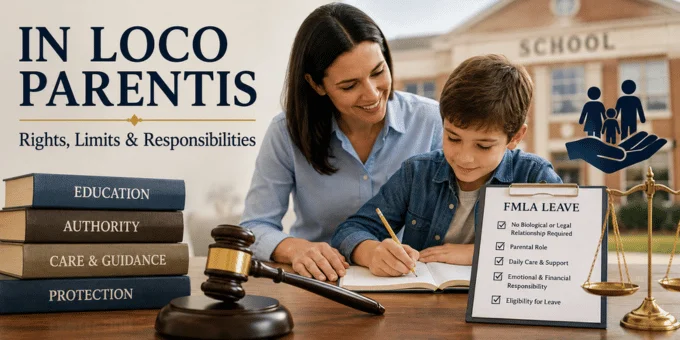
In loco parentis is Latin for “in the place of a parent.” It describes an adult or institution that takes on some parental duties over a minor. The adult acts with real authority yet is not that child’s legal guardian. Schools, camp staff, coaches, and grandparents can all fall under it.
The phrase shows up in school handbooks and in federal leave paperwork, and it means something slightly different in each. Below you’ll find where the rule applies, and the hard limits courts have drawn around it.
Where the doctrine applies, setting by setting
Whether in loco parentis applies at all depends on context. This table compares the five settings people ask about most, day care and summer camp included. Notice the pattern. This authority is temporary and tied to one place and purpose. It ends when the child goes home. Home care agencies and any professional caregiving franchise operate on the same logic when their staff supervises a dependent client.
| In loco parentis | Does the doctrine apply? | What it allows | What it does not allow |
| K-12 public school | Yes, broadly. | Discipline, supervision, reasonable searches, emergency first aid | Corporal punishment in states that ban it, routine medical consent, custody decisions |
| College or university | Almost never | Contract-based conduct codes, campus safety rules | Treating adult students as minors, curfews, disclosing records without consent |
| Summer camp or day care | Yes, while the child is in care | Supervision, behavior rules, first aid under a signed authorization | Surgery consent, travel out of state, anything outside the enrollment agreement |
| Stepparent or grandparent at home | Often yes, by conduct | Day-to-day care, school pickup, FMLA leave eligibility | Automatic custody, inheritance rights, overriding a fit legal parent |
| Coach or activity instructor | Yes, narrowly. | Supervision during the session, safety enforcement | Discipline beyond the program, decisions about the child’s home life |
Key takeaways
- The doctrine gives certain adults limited parental authority, not full legal custody.
- K-12 schools still rely on it heavily. Colleges largely abandoned it after 1961.
- School officials need only reasonable suspicion to search a student, a lower bar than the probable cause police must meet.
- Under the FMLA, no biological or legal tie to a child is required for leave eligibility.
- It never allows an adult to consent to major medical treatment or alter custody.
What standing in a parent’s place actually allows

Courts describe the authority as whatever is reasonably necessary to educate and protect the child. In practice, an elementary school can set behavior rules, hold a student after class, confiscate a phone, or apply a bandage without reaching home first. Two things justify this. Children are compelled to attend, and the adults responsible for them cannot be reached in seconds. The doctrine fills that gap so nobody has to wait for a signature before stopping a fight. “Delegated” is the key word here. A school acts on behalf of the family, so it cannot exceed what a reasonable guardian would do in the same moment.
The limits courts have drawn
This has never been a blank check. What it does not permit is a longer list than most handbooks admit:
- No major medical consent. Non-emergency treatment still requires a legal guardian’s authorization.
- No change to custody or legal status. Standing in a parental role creates no filing right by itself.
- No waiver of the child’s constitutional rights. Students keep First Amendment protection at school, as Tinker v. Des Moines established in 1969.
- No authority off the clock. Once the school day or the camp session ends, so does the standing.
- No override of a fit legal parent. The legal guardian’s objection generally controls.
Discipline is also bounded by state statute. Corporal punishment is illegal in public schools in most states, and this doctrine does not revive it where lawmakers took it away.
Why colleges stopped acting as substitute guardians
Through the 1950s, American colleges regulated dorm hours, dating, and off-campus travel. They expelled students with no hearing. That collapsed with Dixon v. Alabama in 1961, when a federal appeals court held that a public college could not expel students without notice and a hearing.
Two other shifts finished the job. Voting age dropped to 18 in 1971, and most states moved the age of majority to match, so undergraduates became legal adults. Federal privacy law then handed education records to the student instead of the family.
Today the campus relationship is contractual. Colleges enforce conduct codes because students agreed to them, not because the school stands in a guardian’s place. Wondering where a young person sits on that line? How to Choose a Divorce Lawyer Without Regret is a lighter way to see how fast a minority turns into adulthood.
School searches and the reasonable suspicion standard
This is where the doctrine has the sharpest real-world edge. In New Jersey v. T.L.O. (1985), the Supreme Court held that public school officials are state actors bound by the Fourth Amendment. They do not, though, need a warrant or probable cause. Two prongs make up the test.
A search must be justified at its start by reasonable suspicion of a rule or law violation. Its scope must then match that suspicion, and it cannot be excessively intrusive given the student’s age and sex. So a vice principal who smells smoke can open a backpack. Stripping a middle schooler to look for ibuprofen fails the second prong, which is roughly what the Court decided in a later case out of Arizona.
The FMLA angle most guides miss

Federal leave law borrows the same phrase for a different job: deciding who counts as family. Under the Family and Medical Leave Act, an employee who stands in a parental role can take job-protected leave for that child. Birth, bonding, and a serious health condition all count as reasons.
The U.S. Department of Labor’s Wage and Hour Division addressed this in Fact Sheet #28B, updated in March 2025. An employee needs no biological or legal relationship to the child to qualify. Four factors decide it instead: the child’s age, dependency, financial support, and the parental duties performed. That is set out in the DOL guidance on this leave standard. Children who already have one or two legal guardians at home are still covered.
A worked eligibility example
Say Maria has raised her 7-year-old grandson since he was 2. She spends roughly $600 a month on his food and school fees. She takes him to appointments, and he lives with her full time. Her daughter is alive but uninvolved.
Maria has never been to family court, so she has no guardianship order. She still qualifies. Age, dependency, support, and daily duties all point the same way. She can request FMLA leave when her grandson needs surgery. Her employer may ask for a simple written statement of the relationship, not a court document.
How it differs from legal guardianship
People often treat in loco parentis and legal guardianship as the same thing. They are not close.
| Feature | Standing in a parental role | Legal guardianship |
| Court order required | No | Yes |
| How it starts | By conduct and circumstance | By petition and judicial approval |
| Medical and financial decisions | Emergency and routine only | Broad authority |
| How it ends | When the caregiving stops | By court order or the child turning 18 |
| Support obligation | Generally none once care ends | Enforceable while it lasts |
Adoption sits further along the scale. It permanently transfers legal status, including inheritance rights, which no informal arrangement can do.
How the doctrine narrowed over time

- 1800s: English common law imported near-total delegated authority to schoolmasters.
- 1961: Dixon v. Alabama requires due process before expulsion at public colleges.
- 1969: Tinker confirms students keep free speech rights at the schoolhouse gate.
- 1971 to 1975: The age of majority falls to 18 in most states, and federal privacy law shifts records to adult students.
- 1985: T.L.O. makes school officials state actors subject to a reasonable suspicion test.
- 2010 to 2025: Federal leave guidance extends the phrase to grandparents and other informal caregivers.
Conclusion
In loco parentis gives certain adults limited authority to care for, supervise, and protect a child without creating full legal guardianship. Its scope depends heavily on the setting, the responsibilities actually performed, and applicable state law. Schools, caregivers, stepparents, grandparents, and youth-program staff may have different rights and limits.
FMLA rules also recognize informal parental relationships for qualifying leave, while medical consent, custody, and constitutional rights remain subject to separate legal requirements. Because these rules can vary by jurisdiction, the specific state statute, court order, school policy, or federal regulation should be checked before relying on the doctrine.
What to do next
Start with the paperwork you already have. Read your district’s handbook on searches and discipline. Then check what your camp or day care enrollment form authorizes in an emergency. Between them, those two documents settle most questions before anyone needs a lawyer.
Raising a grandchild or stepchild? Write down when the caregiving began and what you cover financially. Employers and courts ask for exactly that record, and a rough monthly figure such as $600 in support helps. When custody, medical consent, or a serious school dispute is on the table, talk to a family law attorney in your state, because the details vary by jurisdiction.
Apart from that, if you want to know about the article Estate Planning Attorneys: Trusted Advisors for Protecting Assets, Ensuring Family Security, and Preserving Your Legacy, then please visit our Law Category.
Frequently asked questions
Yes, in K-12 schools, day care, and informal family caregiving. It is close to dead at colleges, where students are adults with contractual rights.
Teachers can impose reasonable school-based consequences such as detention or loss of privileges. State law and district policy set the ceiling, and physical punishment is banned in most public systems.
No. Marriage alone does not create it. It grows out of daily care and support. That is why a stepparent who raises a child for years may qualify for federal leave while a new spouse would not.
Only with reasonable suspicion that the phone holds evidence of a specific violation. General hunches are not enough, and the search must stay proportionate.
During the session, yes, narrowly. Youth coaches and any fitness instructor supervising minors can enforce safety rules and stop a dangerous activity. That power ends at the door.
Your school district usually owes a duty of reasonable care. Negligent supervision claims turn on whether staff acted as a prudent guardian would. Behavioral history matters, and families often bring in a child psychologist’s perspective when the dispute involves a pattern rather than one incident.