


Which of these powers is considered an implied power? In the standard version of this question, the answer is creating a national bank. Raising taxes, regulating trade, and declaring war are all written into Article I, Section 8. Chartering a bank is not listed anywhere. Congress claims it through the Necessary and Proper Clause, and the Supreme Court agreed in 1819.
Below you get the reasoning, the other answer sets test writers use, and a method you can reuse on any version of this question.
Key Takeaways
- The correct choice is almost always creating a national bank.
- Powers spelled out in the text are called enumerated or expressed powers.
- Unlisted authority flows from Article I, Section 8, Clause 18, the Necessary and Proper Clause, also called the elastic clause.
- McCulloch v. Maryland (1819) is the case that made this doctrine real.
- Other common right answers: drafting an army, establishing the Air Force, setting a minimum wage, and regulating nuclear power.
- Inherent powers are a third category, and quizzes love to mix them in.
Three Types of Federal Authority, Side by Side
Most students miss this question because the three categories blur together. This table keeps them apart.
| Category | Where it comes from | Examples | Quiz signal |
|---|---|---|---|
| Enumerated (expressed) powers | Listed by name in the Constitution, mostly Article I, Section 8 | Coin money, declare war, raise taxes, regulate interstate trade, establish post offices | You can point to a line of text |
| Implied powers | Read into the Necessary and Proper Clause as tools for carrying out listed powers | National bank, military draft, Air Force, federal minimum wage, nuclear regulation | Not in the text, but supports something that is |
| Inherent powers | Belong to any sovereign nation by its nature, not traced to a clause | Acquire territory, recognize foreign governments, control immigration and borders | About nationhood and foreign affairs |
Where the Constitution Hides This Authority
Article I, Section 8 runs through seventeen specific grants, then closes with an eighteenth that changes everything. The Constitution Annotated, published by the Library of Congress, prints Clause 18 in full. Congress may “make all Laws which shall be necessary and proper for carrying into execution the foregoing Powers.” If you want to go deeper, read Fee Simple Explained in Full.
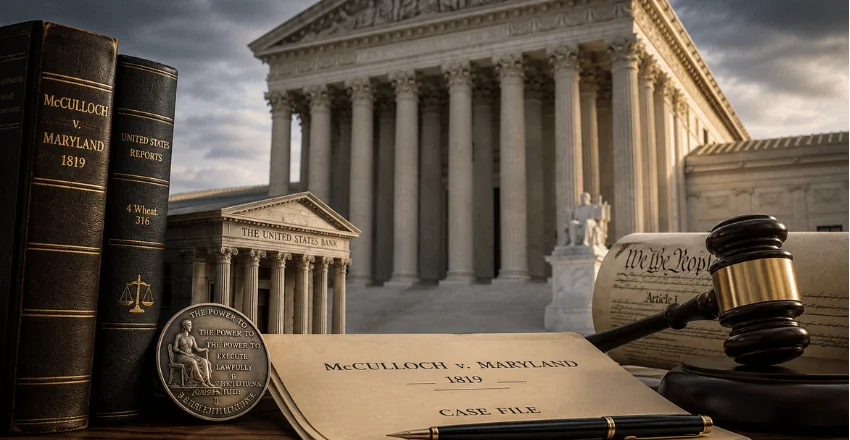
Its analysis of the 1819 ruling in McCulloch v. Maryland records the holding that the narrow reading of “necessary” as “indispensably necessary” had to be abandoned. That 1819 decision let the bank, capitalized at $10 million, stand against a hostile state tax.
Teachers call Clause 18 the elastic clause because it stretches. It does not stretch on its own, though. It only reaches as far as some listed power lets it go.
Which of These Powers Is Considered an Implied Power? Option by Option
Here is the classic four-option version, with each choice analyzed rather than just crossed out.
| Option | Verdict | Why |
|---|---|---|
| A. Raising taxes | Enumerated | Clause 1 grants the power to lay and collect taxes, duties, imposts, and excises. |
| B. Regulating trade | Enumerated | Clause 3, the Commerce Clause, names it directly. |
| C. Creating a national bank | Implied; the answer | No clause mentions banks. It rides on taxing, borrowing, and currency powers. |
| D. Declaring war | Enumerated | Clause 11 gives Congress the power to declare war. |
Notice the pattern the test writer used. Three options are famous phrases lifted straight from the document. Choice C is a concrete institution nobody in 1787 wrote down. That contrast is the whole trick.
The 1791 Fight Behind the Answer
Alexander Hamilton wanted a Bank of the United States funded with $10 million in capital. Thomas Jefferson argued that if the Framers had wanted a bank, they would have said so, and that loose readings would swallow the states whole. President Washington sided with Hamilton, and the bank got its charter in February 1791.
That argument still shapes American politics. Strict construction says stick to the text. Loose construction says the text grants ends, and Congress picks the means. If you enjoy the founding era context behind fights like this, the Jemima Boone frontier story covers the same generation from a very different angle.
Other Answer Sets You Might Get
Question banks rotate their options, so memorising one answer is risky. These are the choices that count as unlisted authority in most textbooks:
- Drafting soldiers. The text lets Congress raise and support armies. Conscription is the method.
- Creating the Air Force. The Constitution names armies and a navy. Aircraft came later.
- Setting a federal minimum wage. Built on the commerce power.
- Regulating nuclear power plants. Also commerce, plus national defense.
- Building the interstate highway system. Roads that serve commerce and defence.
- Running federal prisons and drug enforcement. Tools for enforcing valid federal laws.
If your options include coining money, granting patents, or establishing post offices, skip them. Each one is named in the text.
Why Textbooks Keep Asking It
Which of these powers is considered an implied power? The question survives on quizzes because it checks two skills at once. First, can you recall what Article I, Section 8 actually contains? Second, can you tell a granted end from a chosen means? Students who memorise a list of examples pass the first check and fail the second.
Graders notice the difference in the short-answer version. A weak response names the bank and stops. A strong one names the bank, cites Clause 18, and explains that Congress needed a fiscal tool to collect taxes, borrow money, and pay the army. Reasoning earns the credit, not the noun.
Landmark Cases That Built the Doctrine
| Case | Year | What it settled |
|---|---|---|
| McCulloch v. Maryland | 1819 | Congress may charter a bank, and states may not tax it. |
| Wickard v. Filburn | 1942 | Even wheat grown for home use can be reached under the commerce power. |
| United States v. Lopez | 1995 | Guns near schools were too far from commerce, so the law fell. |
| United States v. Comstock | 2010 | Civil commitment of certain federal prisoners was a proper means. |
| NFIB v. Sebelius | 2012 | The insurance mandate failed as a “proper” means, though it survived as a tax. |
The Limits Nobody Mentions
Clause 18 is not a blank check. It is not an independent grant of authority at all. It gives Congress the means to execute powers granted elsewhere, which means every claim has to trace back to a real listed power. Courts have enforced that line. Lopez struck down a federal gun law in 1995.
In 2012, the Court rejected the argument that the individual mandate was a proper way to carry out insurance reform. Federal reach also gets policed after the fact through prosecutions. That is why cases like the Nadine Menendez corruption case draw attention to how federal authority gets used.
A Three-Step Test for Any Version of This Question

- Search the text. Is the phrase in Article I, Section 8? If yes, it is enumerated, and it is not your answer.
- Ask what it serves. If the option is a tool for something listed—taxing, commerce, war, or currency—it belongs in the unlisted category.
- Check for sovereignty. If it involves territory, borders, or recognizing other nations, you are looking at an inherent power instead.
Run those three steps, and you will not need to memorise anything. That same logic explains modern policy fights. Look at reporting on Meta layoffs and federal oversight, where the question is always which listed power a given rule rests on.
Your Next Step
Lock in the answer, then test yourself. Write down five federal actions from this week’s news and sort each one into enumerated, unlisted, or inherent using the three-step method above. If you can defend each placement in a sentence, you are ready for the exam question and for the essay version that usually follows it.
Frequently Asked Questions
Creating a national bank, in the most common version. If the options differ, pick the choice that is not written in Article I, Section 8 but supports something that is.
Authority Congress can reasonably use to carry out a power the Constitution actually lists. Nothing in the text names it, and the courts allow it.
Yes. Two names, one provision: Article I, Section 8, Clause 18.
Nothing meaningful. Both mean powers written out in the text. Textbooks use the terms interchangeably.
States hold reserved powers under the Tenth Amendment, which is a broader grant. State constitutions can also include their own necessary and proper-style language.
Yes. Selective Service registration continues, and the underlying authority stands whether or not it is being used.
Federal courts, and the Supreme Court has the final word. Political commentary tracks these fights closely, and writers like political journalist Jane Coaston cover how those rulings land in public debate.