



An ERISA attorney handles employer-sponsored benefit claims that an insurer has denied, including long-term disability, life insurance, health coverage, and pension benefits. Your lawyer builds the administrative appeal and forces the plan to hand over its file. If the denial stands, they sue in federal court to recover the benefits you were promised.
Your denial letter came with a deadline, and that deadline is shorter than most people assume. Miss it, and you usually lose the right to sue at all. Here is what a benefits lawyer does, what one costs, and how to tell whether you need one.
Key takeaways
- You generally get 180 days from a disability denial to file the internal appeal. That is the single most important date in your file.
- Appeals win cases, not lawsuits. Evidence you leave out now is usually locked out of court later.
- Most plans contain a discretionary clause, which means a judge reviews the insurer’s decision for abuse of discretion instead of deciding the facts afresh.
- Fees are typically contingent, often 25% to 40% of what you recover, and a court can order the insurer to pay your fees on top.
- Recovery is limited to unpaid benefits and interest. There are no punitive damages and, in most cases, no jury.
Where a benefits lawyer fits into the claim
| Initial claim | Plan rules, often 90 days from disability onset | Reviews the policy language, lines up medical proof | Free consult, sometimes hourly review |
| Denial received | Act within days, not weeks | ERISA Attorney demands the claim file and plan documents at no charge | Usually nothing upfront |
| Administrative appeal | At least 180 days for disability plans | Builds the record: reports, vocational proof, rebuttals | Contingency, commonly 25% to 40% |
| Federal lawsuit | Set by the plan’s own limitations clause | Briefs the case on the closed record | Same contingency, costs advanced |
| Ongoing benefits | Continuous while you are paid | Answers surveillance and review demands | Often a lower percentage of monthly checks |
What This Federal Law Actually Covers: ERISA Attorney Guidance

The Employee Retirement Income Security Act of 1974 governs almost every benefit plan you get through a private employer. That sweeps in group disability policies, group life insurance, employer health plans, pensions, and 401(k) accounts. An ERISA Attorney can help you understand how these protections apply to your specific benefits. Plans bought directly from an insurer, plus government and church plans, usually sit outside it.
People often discover this the hard way after a job ends. If you are sorting out coverage during a reduction in force, our guide to Meta layoffs and severance benefits walks through how group coverage unwinds when employment stops.
Signs you should call a lawyer now
- Your denial cites a “lack of objective evidence” for a condition that has no objective test.
- A hired doctor reviewed paper records without ever examining you.
- Benefits stopped at the 24-month mark, when the definition of disability shifted from your own job to any job.
- Your letter mentions a mental health or self-reported symptom limit.
- You were told video surveillance contradicts your restrictions.
- Someone at the plan is refusing to send you the file it relied on.
That last one matters more than it sounds. Plan administrators must give you the documents and the claim file free of charge on request. A good lawyer sends that demand the same week.
The deadline timeline nobody sends you.
According to the Department of Labor guide Filing a Claim for Your Disability Benefits, a plan must allow at least 180 days to appeal a denial. The Employee Benefits Security Administration enforces that rule under 29 CFR 2560.503-1. Plans get 45 days to decide the original claim, with one 30-day extension. Once your appeal lands, they have 45 days to rule, plus a possible 45 more.
| Decide initial disability claim | Plan | 45 days | Up to 30 days |
| File administrative appeal | You | At least 180 days | None as of right |
| Decide the appeal | Plan | 45 days | Up to 45 more days |
| Decide a group health claim appeal | Plan | 60 days for post-service claims | Limited |
| File suit in federal court | You | Whatever the plan document says, sometimes 3 years | None |
Read your plan document for the suit limitation clause. Courts enforce those contractual deadlines, and some run from the date proof of loss was due rather than the date of denial.
Why the appeal is the real trial
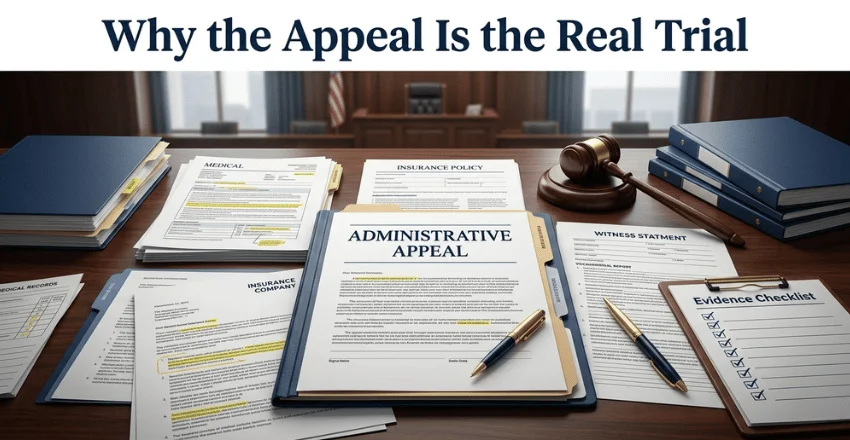
Here is the rule that surprises almost everyone. When the internal appeal ends, the administrative record closes. A judge later reads that record and, with rare exceptions, nothing else. An appeal is not a form you fill in. It is your entire case. A benefits lawyer treats it like a trial brief. In go updated treating physician opinions, a functional capacity evaluation, vocational analysis, and wage records.
Add sworn statements from coworkers and a point-by-point rebuttal of the insurer’s reviewing doctors. People appealing alone tend to send a two-paragraph letter saying they disagree. That letter becomes the whole record. Benefits questions also surface when work itself changes shape. Our overview of Wayfair remote jobs and benefits is worth a look if you are weighing an accommodation against a claim.
The standard of review that decides your odds
Most plan documents include a discretionary clause granting the administrator authority to interpret terms and decide eligibility. Where that clause is valid, a judge applies abuse of discretion review. Under that standard, your insurer wins if its decision was merely reasonable, even where the judge would have decided the case differently.
Without a valid clause, review is de novo and the court decides the question fresh. Several states, including California and Michigan, ban discretionary clauses in insurance policies. Which side of that line your plan falls on can change your chances more than any single medical report.
What an ERISA attorney charges
Almost all claimant-side benefits lawyers work on contingency. Typical range: 25% to 40% of the recovery, with 33% most common. Case costs such as records and expert reports are either advanced or billed separately. A worked example helps. Say your long-term disability benefit is $4,000 a month and the insurer wrongly cut you off 20 months ago.
- Back benefits recovered: $80,000
- Attorney fee at 33%: $26,400
- Case costs, records, and one expert report: $2,100
- Net to you: $51,500, plus reinstated benefits in the future
Then there is fee-shifting. Under 29 U.S.C. 1132(g), a court has discretion to order the losing plan or insurer to pay your attorney fees and costs. You need not win outright to qualify, only to show some success on the merits. When a fee award lands, it can offset much of the contingency bite.
Your three real options, compared
| Appeal on your own | Clear clerical errors, small claims | No fee | You may close the record with a thin file |
| General practice lawyer | Nothing, honestly, in this niche | Local and familiar | May miss the record rule and the deadline clause |
| Benefits specialist | Any disability or life denial worth over $25,000 | Builds a record designed for federal review | Takes a percentage of the award |
The verdict: if your claim is worth more than roughly a year of benefits, hire a specialist. A contingency fee costs less than a poorly built record. That costs you everything.
What you can and cannot recover

You can recover unpaid benefits, reinstatement of future benefits, prejudgment interest, and possibly fees. You cannot recover pain and suffering, emotional distress, or punitive damages, no matter how badly the insurer behaved. Jury trials are generally unavailable, so a judge decides on the papers.
Retirement claims follow the same statute but look different in practice. Miscalculated pensions, missing 401(k) contributions, and imprudent plan investments are fiduciary breach cases. If you are rebuilding savings while a claim is pending, our rundown of business investment opportunities covers where else money can work.
Your next step
Find your denial letter and write the date you received it at the top. Count forward 180 days and put that date on your calendar. Then request the complete claim file and plan documents in writing, and get a denial letter reviewed by an ERISA attorney before you send anything substantive to the insurer. One well-built appeal beats three rushed ones. Start today, because the calendar is the one thing no lawyer can fix later.
Frequently asked questions
For disability plans, at least 180 days from the date you receive the adverse determination. Group health plans also run on 180 days for most claims. Check the denial letter, because the plan must state the deadline in writing.
No. Courts require you to exhaust the plan’s internal process first. Filing early usually gets the case dismissed, and by then the appeal window may be gone.
Budget 3 to 9 months for the appeal cycle, including extensions. If suit is needed, add 12 to 24 months. Many cases settle once the record is strong and the insurer sees its exposure.
Nearly every claimant-side firm reviews a denial letter free. Bring the letter, the policy or summary plan description, and your medical records list.
Yes. Group life claims denied over lapsed coverage, conversion rights, or a beneficiary dispute run through the same appeal and lawsuit path.
Your correspondence goes to the plan administrator, which may be your employer or the insurer. The statute prohibits retaliation for pursuing benefits.
Those are usually exempt. State law and state court remedies may apply instead, which can mean broader damages.