

Managing event production has become increasingly challenging as businesses face rising labor costs, tighter event schedules, and growing client expectations. Whether organizing live performances, corporate events, festivals, school programs, or community gatherings, companies are expected to deliver professional results while keeping operational expenses under control. One area receiving significant attention is staging. Many organizations that once relied on conventional staging systems are now evaluating modern alternatives that offer greater efficiency without compromising performance or safety.
A concert stage is one of the most important components of any live event, influencing audience experience, performer safety, and production quality. At the same time, the emergence of the portable stage has transformed how event professionals approach setup, transportation, storage, and labor management. Similar to how organizations streamline operations in industries ranging from online fundraising to candy bar fundraisers, event businesses are increasingly seeking scalable solutions that improve productivity while maintaining consistent quality.
This shift is not simply about purchasing new equipment. It reflects a broader effort to optimize operations, reduce unnecessary labor, improve scheduling flexibility, and maximize long-term value. Understanding the factors behind this transition can help businesses make informed decisions that align with their operational goals and event requirements.
The Growing Pressure to Reduce Labor Costs
Labor represents one of the largest operational expenses for event organizers and production companies. Beyond hourly wages, businesses must also account for overtime, specialized technicians, training, travel expenses, and scheduling logistics.
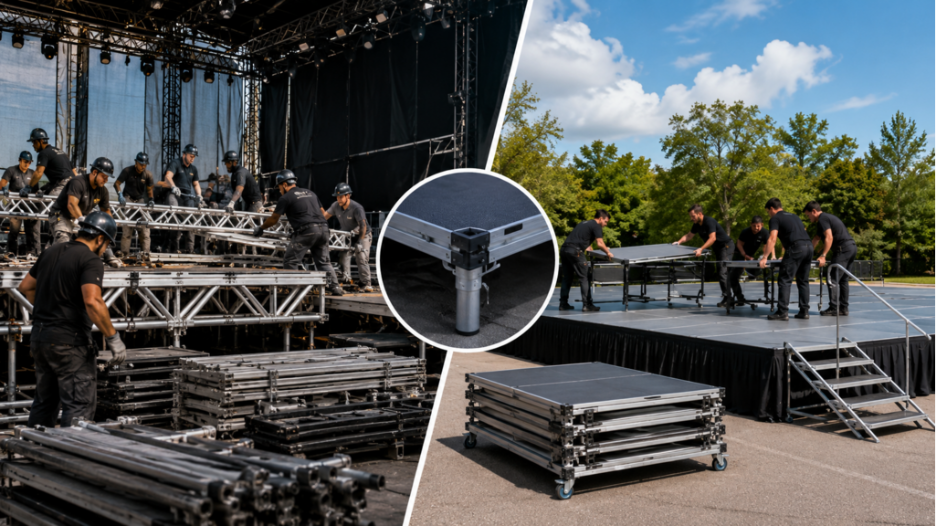
Traditional staging systems often require large crews to unload heavy components, assemble structural elements, verify alignment, and dismantle everything after an event concludes. Even experienced crews may spend several hours preparing a medium-sized venue, depending on the complexity of the design.
As labor markets tighten and wages continue to rise in many regions, organizations are looking for ways to accomplish the same work with fewer personnel. Reducing labor requirements not only lowers direct costs but also allows companies to allocate staff toward customer service, technical production, logistics, or other revenue-generating activities.
However, reducing labor should never mean reducing quality. The challenge lies in improving efficiency while maintaining safety, reliability, and professional presentation.
Why Traditional Staging Systems Require Significant Resources
Conventional staging systems have served the events industry for decades and continue to perform well in many large-scale productions. Their structural strength and customization capabilities make them suitable for highly specialized events.
Nevertheless, these systems often introduce operational complexities that affect overall project costs.
Heavy structural components require additional workers during loading and unloading. Assembly frequently involves specialized tools, multiple fastening systems, and detailed installation procedures that increase setup times. Storage requirements may also be substantial, particularly for companies managing multiple events simultaneously.
Transportation represents another consideration. Larger staging systems require bigger vehicles, additional fuel, and more loading time. These factors accumulate across dozens or even hundreds of events annually, creating expenses that extend beyond the initial equipment investment.
While these systems remain valuable for certain applications, businesses must evaluate whether every event truly requires such resource-intensive infrastructure.
How Portable Solutions Are Changing Event Operations
Modern staging technology emphasizes efficiency without sacrificing professional standards. A portable stage is designed to simplify transportation, assembly, storage, and configuration while supporting a wide range of event types.
Instead of relying on numerous loose structural components, many modular systems incorporate folding frames, lightweight materials, and tool-free assembly mechanisms. These design improvements allow smaller crews to complete installations more quickly while maintaining consistent structural integrity.
The operational benefits extend throughout the event lifecycle. Faster loading reduces transportation delays. Simpler assembly shortens venue occupancy time. Easier dismantling enables crews to prepare for subsequent events more efficiently.
Rather than replacing craftsmanship or technical expertise, portable systems allow experienced personnel to focus on production quality instead of repetitive manual labor.
Maintaining Professional Standards While Improving Efficiency
One common concern surrounding labor reduction is whether efficiency compromises event quality. In practice, quality depends on multiple factors beyond the number of workers involved.
Professional appearance remains essential regardless of the staging system used. Stable platforms, clean finishes, proper leveling, secure connections, and attractive stage configurations continue to define successful events.
Many modern modular systems are specifically engineered to provide these characteristics while reducing unnecessary installation complexity. Standardized components improve consistency between events, helping organizations deliver predictable results regardless of venue size.
Quality also depends heavily on planning. Accurate venue measurements, thoughtful equipment selection, and trained installation crews remain essential regardless of whether a business uses traditional or modular staging.
Reducing labor becomes most effective when accompanied by improved processes rather than simply assigning fewer workers.
Faster Setup Creates Additional Business Opportunities
Time savings generate value that extends beyond payroll reduction.
Every hour saved during setup allows businesses to schedule additional events, reduce overtime, or accommodate unexpected client requests. This flexibility can become a competitive advantage in industries where venue access windows continue shrinking.
For example, convention centers, hotels, schools, and municipal facilities frequently limit installation periods due to multiple events sharing the same location. Faster staging enables organizations to meet these scheduling constraints more comfortably.
Production companies may also benefit from completing multiple installations within a single day using the same equipment and crew. Increased utilization improves overall return on investment while reducing operational bottlenecks.
In this context, efficiency directly supports business growth rather than simply lowering expenses.
Transportation Efficiency Matters More Than Ever
Transportation costs have become an increasingly important consideration for event businesses.
Fuel prices, vehicle maintenance, driver availability, and logistics planning all contribute to overall operating expenses. Bulky staging systems often require larger trucks or multiple transport vehicles, increasing both direct and indirect costs.
Lighter modular equipment can reduce vehicle requirements, improve loading efficiency, and simplify inventory management. Smaller shipments may also reduce loading times, allowing crews to spend more time preparing venues instead of handling equipment.
Organizations managing regional tours or frequent venue changes often experience particularly noticeable benefits from improved transportation efficiency.
However, businesses should evaluate transportation savings alongside durability and load capacity rather than focusing exclusively on weight reduction.
Flexibility Across Different Event Types
Modern event businesses rarely specialize in a single event category.
A company might organize concerts one weekend, corporate conferences the next, followed by graduation ceremonies, fashion shows, product launches, community festivals, or worship services.
Versatility therefore becomes an important purchasing consideration.
Modular staging allows organizations to adjust layouts according to audience size, venue dimensions, performer requirements, and production objectives. Sections can often be expanded, reduced, or reconfigured without requiring entirely different staging inventories.
This adaptability helps businesses maximize equipment utilization while minimizing unnecessary capital expenditures.
Instead of maintaining multiple specialized systems, companies can often serve diverse clients using one flexible platform.
Safety Should Never Be Compromised
Reducing labor costs should never come at the expense of safety.
Every staging installation must support expected loads, remain stable throughout performances, and comply with applicable regulations and manufacturer guidelines.
Businesses should carefully evaluate structural certifications, load ratings, locking mechanisms, guardrail compatibility, accessibility options, and maintenance requirements before selecting any staging solution.
Crew training also remains essential.
Even equipment designed for rapid assembly requires personnel who understand proper installation procedures, inspection protocols, and operational best practices.
Investing in employee training often produces greater long-term value than simply attempting to reduce staffing levels.
Safe operations protect performers, audiences, employees, and organizational reputation.
Understanding the Trade-Offs Between Traditional and Portable Systems
Every staging solution involves compromises.
Traditional systems often excel in highly customized, permanent, or exceptionally large productions requiring specialized engineering. They may offer extensive configuration possibilities suitable for complex touring concerts or major entertainment venues.
Portable alternatives prioritize efficiency, flexibility, and operational simplicity.
Businesses should carefully assess their typical event portfolio before making purchasing decisions.
Organizations serving diverse clients with varying venue sizes may benefit significantly from modular equipment.
Conversely, companies producing highly specialized large-scale concerts every week may continue relying on traditional systems for certain applications.
Rather than viewing these approaches as competitors, many organizations successfully integrate both into their equipment inventories.
The most appropriate choice depends on business objectives rather than industry trends.
Storage Considerations Affect Long-Term Costs
Storage often receives less attention during purchasing decisions despite representing a recurring operational expense.
Large staging components occupy valuable warehouse space, potentially increasing facility costs or limiting inventory expansion.
Compact modular systems typically require less storage volume, allowing businesses to organize equipment more efficiently.
Improved storage efficiency also reduces loading errors and simplifies inventory tracking, helping crews locate required components more quickly before events.
Over several years, these operational improvements can contribute meaningful financial savings.
Equipment Longevity and Maintenance
Initial purchase price should not determine staging investments in isolation.
Businesses should evaluate expected service life, maintenance requirements, replacement part availability, and repair complexity.
High-quality modular systems frequently use standardized components, simplifying maintenance and reducing downtime when individual parts require replacement.
Preventive maintenance remains essential regardless of staging type.
Regular inspections, cleaning, proper storage, and routine hardware replacement extend equipment lifespan while preserving safety standards.
Long-term ownership costs often provide a more accurate measure of value than purchase price alone.
Technology Is Supporting More Efficient Event Management
Modern event operations increasingly combine physical equipment with digital planning tools.
Project management software, digital inventories, transportation scheduling platforms, and venue mapping applications help businesses coordinate staging logistics more efficiently.
When staging systems themselves are designed for quick deployment, these technological improvements become even more valuable.
Accurate planning minimizes installation delays, reduces scheduling conflicts, and improves communication among production teams.
Businesses that integrate efficient equipment with organized workflows often achieve greater productivity than those focusing on either factor independently.
Environmental Considerations Are Becoming More Important
Sustainability is becoming an increasingly relevant consideration for many organizations.
Reducing transportation requirements may lower fuel consumption and associated emissions. Durable staging systems designed for long service lives also reduce material waste by minimizing replacement frequency.
Efficient storage facilities may consume fewer resources, while streamlined logistics can reduce unnecessary vehicle movements between warehouses and venues.
Although environmental considerations may not drive every purchasing decision, they increasingly complement financial and operational objectives.
Evaluating Return on Investment
Calculating return on investment requires examining multiple variables rather than focusing solely on labor savings.
Businesses should consider:
- Annual event volume
- Average setup and dismantling time
- Crew size requirements
- Transportation expenses
- Equipment maintenance
- Storage costs
- Revenue opportunities created by faster deployment
- Equipment lifespan
A staging solution that costs more initially may ultimately generate greater long-term value if it significantly improves operational efficiency.
Decision-makers should evaluate total ownership costs over several years rather than emphasizing short-term purchasing budgets.
Making the Right Decision for Your Business
There is no universal staging solution suitable for every organization.
Businesses should begin by assessing the types of events they produce most frequently, typical venue characteristics, staffing availability, transportation logistics, and long-term growth objectives.
Companies experiencing increasing labor costs, expanding event schedules, or storage limitations may find that modular staging aligns well with their operational priorities.
Meanwhile, organizations managing highly customized productions may continue benefiting from traditional staging for specific applications while introducing portable solutions for smaller or more flexible events.
Careful evaluation, realistic budgeting, and long-term planning will produce more effective decisions than simply following industry trends.
Wrapping Up
The movement toward more efficient staging reflects broader changes occurring throughout the live events industry. Rising labor costs, tighter schedules, and increasing client expectations are encouraging businesses to rethink how events are delivered without compromising professionalism or safety.
While traditional systems continue to serve important roles, many organizations are discovering that a portable stage offers meaningful advantages in setup efficiency, transportation, storage, and operational flexibility. At the same time, a well-designed concert stage remains essential for creating engaging audience experiences and supporting successful performances.
The most successful businesses recognize that reducing labor costs is not about doing less work—it is about accomplishing the same objectives through smarter planning, better equipment, skilled personnel, and thoughtful investment. By carefully balancing efficiency, quality, safety, and long-term value, organizations can build event operations that remain competitive in an evolving marketplace.