


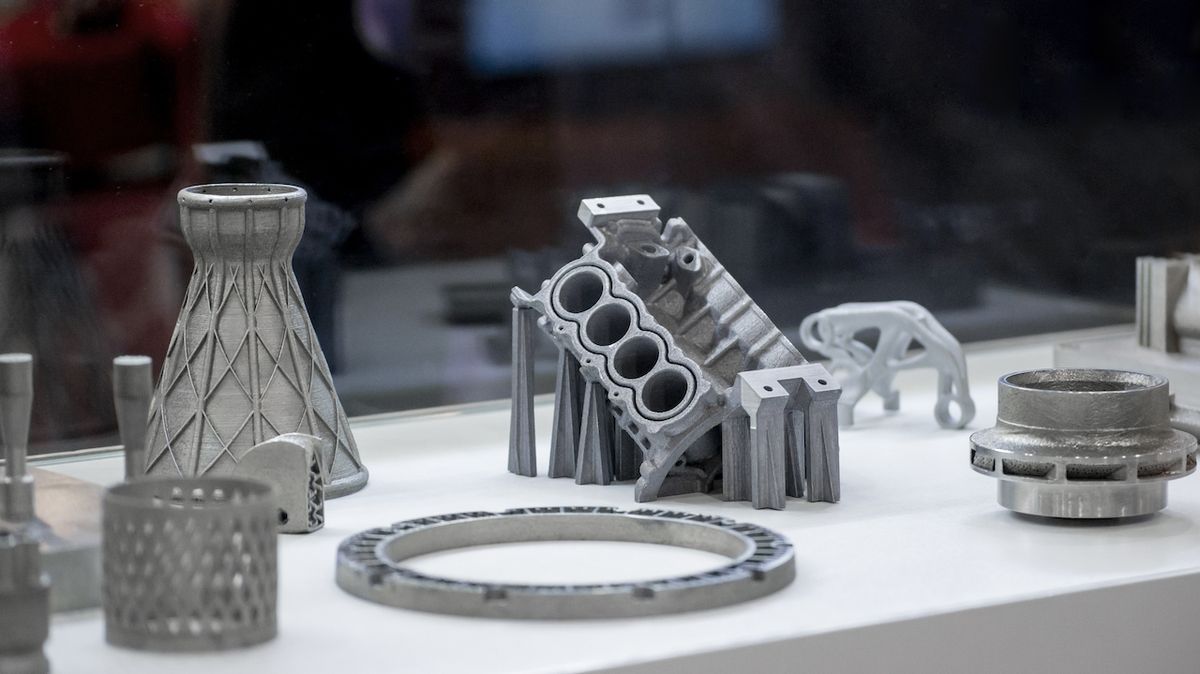
Material choice changes almost everything about a printed metal part, from weight and heat resistance to corrosion performance and final cost. Metal 3D printing now works with several engineering alloys that would be difficult, slow, or wasteful to shape by conventional methods. Each alloy behaves differently during printing, so the right choice depends on how the finished component will actually be used.
GRCop-42 Copper Alloys for High-Heat Rocket Propulsion
GRCop-42 was developed for parts that face severe heat while still needing strong mechanical performance. Copper gives the alloy excellent thermal conductivity, while chromium and niobium improve strength at elevated temperatures. Rocket combustion chambers, liners, and other propulsion hardware can benefit because heat needs to move away from hot surfaces quickly. Powder bed fusion 3D printing can form cooling passages directly inside these parts, including curved channels that are difficult to drill or machine. Engineers still have to control powder quality, build parameters, and post-processing because copper-based materials respond strongly to laser energy and thermal cycling. Huntsville additive manufacture work is especially relevant here because aerospace and propulsion programs often require complex thermal hardware in small production volumes.
Inconel 718 Superalloys for High-Strength Aerospace Components
Inconel 718 is a proven nickel-based superalloy for hot service. Its strength holds up well under heat, pressure, and repeated loads, which explains its use in turbine hardware, engine components, brackets, and propulsion systems. Additive manufacture can turn the alloy into shapes that reduce assemblies or place material only where loads require it. Such freedom helps, but the printed part still needs a carefully controlled thermal history to achieve dependable properties.
Heat treatment plays a major role after printing. Solution treatment and aging can develop the precipitation-hardened structure that gives Inconel 718 much of its strength. Machining may also be needed on sealing faces, threads, bores, and other tight-tolerance features. Industrial 3D printing therefore works best when designers plan the printed geometry and finishing steps together rather than treating post-processing as an afterthought.
Titanium Alloys (Ti-6Al-4V) for Lightweight Structural Integrity
Ti-6Al-4V combines low weight, high specific strength, and strong corrosion resistance. Aerospace structures, medical devices, motorsport parts, and high-performance mechanical assemblies often use it where steel would add too much mass. Printing titanium additively can reduce the expensive stock wasted by conventional machining. Layer-based production places material closer to the final shape and can also create internal lattices, thin walls, and consolidated structures. Careful shielding from oxygen remains important because hot titanium reacts easily with the surrounding atmosphere. Controlled build chambers, qualified powder handling, heat treatment, and inspection all contribute to reliable results.
Stainless Steel Graded Powders for Corrosion-Resistant Engineering
Stainless steels give manufacturers a broad mix of corrosion resistance, strength, toughness, and finishing options. Grades such as 316L are common where moisture, chemicals, or outdoor exposure are concerns. Other stainless grades may be selected for greater hardness or strength after heat treatment. Rapid manufacturing 3D printing can make manifolds, housings, brackets, tooling components, and fluid-handling parts without requiring a large production run.
Feedstock characteristics matter beyond the alloy name. Particle shape, size distribution, flowability, oxygen content, and recycling history can all affect how evenly each layer spreads. A qualified metal 3D printing Huntsville AL provider may track those variables alongside machine settings and build records. Consistent powder management helps reduce defects and makes it easier to repeat a successful process across later production batches.
Aluminum Alloys for High-Performance Thermal Management
Aluminum offers low density and strong thermal conductivity, which makes it useful for heat exchangers, electronics housings, lightweight brackets, and aerospace hardware. Certain printable aluminum alloys can support thin walls and complex cooling features that can be difficult to machine. With powder bed fusion 3D printing, engineers can combine passages, mounting features, and structural ribs into one piece. Surface finish and fatigue performance still deserve attention, especially on parts exposed to repeated loading. Depending on the application, machining, heat treatment, or surface finishing may follow the build.
Cobalt-Chrome Alloys for Extreme Wear and Biocompatible Demands
Cobalt-chrome alloys stand out for hardness, wear resistance, corrosion behavior, and strength at elevated temperatures. Medical and dental components have used these alloys for years because certain grades can meet biocompatibility requirements. Energy, aerospace, and industrial applications also use cobalt-chrome where surfaces face friction or aggressive environments. Fused deposition modeling works differently because it normally deposits thermoplastic material rather than fully melting metal powder. This makes fused deposition modeling 3D printing useful for prototypes, fixtures, patterns, and support tooling, but it does not replace a metal process when the final component needs cobalt-chrome properties.
Process selection should follow the service conditions rather than the appeal of any single printing method. Geometry, temperature, load, corrosion, wear, inspection needs, and production quantity all influence whether a metal alloy is practical. For that evaluation, Additive Manufacturing Engineering can serve as a resource for organizations comparing alloys, metal additive processes, and finishing requirements for demanding parts. Experience with metal additive manufacturing can help teams assess whether a design fits powder-based production, another rapid manufacturing 3D printing route, or a more conventional method before production begins.