


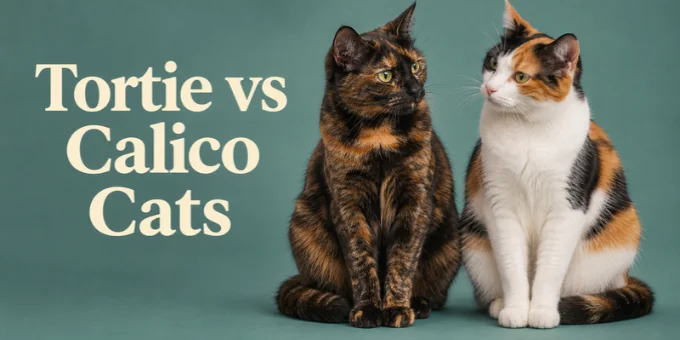
A tortie vs calico comparison usually comes down to white fur and how the colors are arranged. Torties usually blend black and orange closely together, with little or no white. Calicos combine black and orange with obvious white areas, often creating larger and more separated patches.
Neither name describes a specific cat breed. Both describe coat-color patterns that can occur in several breeds and mixed-breed cats. Genetics also explains why almost every cat with either pattern is female.
| Feature | Tortie | Calico |
|---|---|---|
| Main colors | Black and orange | Black, orange, and white |
| White fur | Little or none | Clearly present |
| Color arrangement | Mottled, brindled, or mixed | Larger, separated patches |
| A breed? | No | No |
| Typical sex | Almost always female | Almost always female |
| Dilute form | Blue-gray and cream | Blue-gray, cream, and white |
| Tabby variation | Torbie | Calico with tabby markings may use other registry terms. |
Direct answer: Torties usually have closely mixed black and orange fur with little or no white. Calicos have the same orange-and-black combination plus noticeable white areas. The added white often makes a calico’s colored patches look larger and more clearly separated.
Key Takeaways
- A tortoiseshell cat usually has black and orange colors blended throughout the coat.
- A calico cat adds obvious white areas to the black-and-orange coloring.
- Both patterns result partly from genes carried on the X chromosome.
- Almost all cats with these patterns are female.
- Dilute versions replace black and orange with blue-gray and cream.
- A torbie has tortoiseshell coloring combined with visible tabby markings.
- Coat color does not reliably determine a cat’s personality.
- Neither pattern identifies a cat’s breed.
Tortie vs Calico: 7 Differences That Make Identification Easier
1. White Fur Is the Fastest Clue
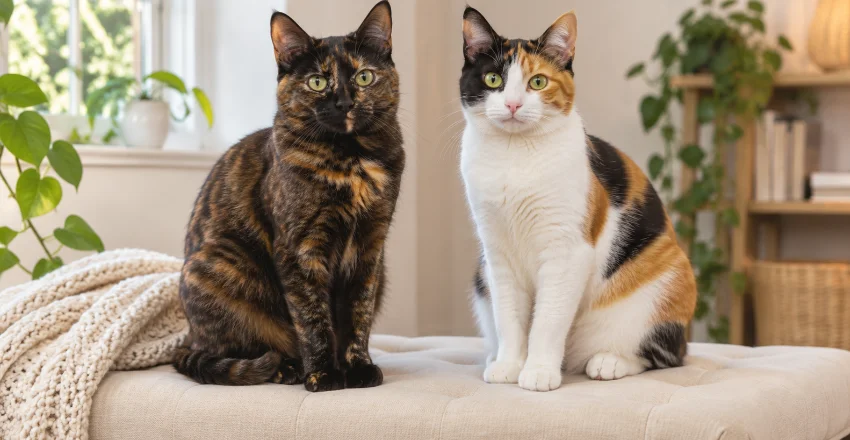
White fur provides the easiest starting point for most U.S. cat owners. A classic tortie has black and orange coloring with little or no white. A calico has clearly visible white combined with those two colors. The boundary can become less obvious when a cat has only a small white patch. American naming sometimes calls such cats tortie-and-white rather than calico. Larger white areas make the calico label much clearer.
2. Tortie Colors Usually Look More Blended
Tortoiseshell coloring often resembles a dense mosaic of dark and orange hairs. Small flecks, streaks, and irregular patches may appear across the body. Some cats also have a striking split-color face. Calico coloring usually looks more separated because white breaks the coat into larger colored areas. Black and orange sections can therefore appear more distinct.
University of Florida identification materials describe calicos as tortoiseshell cats with large white patches.
3. Their Genetics Start With the Same Color System
Both patterns depend on the genetic system controlling orange and non-orange coloration. That color information is associated with the X chromosome. Random X-chromosome inactivation creates groups of cells expressing different colors. Calicos also have genetic factors that produce white spotting. Those white areas separate colored sections and change the coat’s visual appearance.
This explains why the two patterns can share colors while looking noticeably different. Recent genetics research has also clarified the molecular basis of orange fur. Studies identified altered ARHGAP36 activity as an important part of orange coloration. That discovery adds detail to the familiar X-linked explanation.
4. Both Patterns Are Almost Always Female
Female cats normally have two X chromosomes, which allows different color instructions to appear in separate cell groups. Males normally have one X and one Y chromosome. That arrangement makes a mixed orange-and-black male extremely uncommon. Rare males can have an additional X chromosome or another unusual genetic arrangement.
These cats may show tortoiseshell or calico coloring despite being male. Many XXY males are infertile, so sex should never be assumed from color alone.
5. Both Can Have Dilute Versions
Not every tortoiseshell coat uses deep black and bright orange. Dilution genes can soften those colors into blue-gray and cream. The basic pattern remains recognizable even though the palette looks lighter. Dilute calicos show blue-gray, cream, and white instead of black, orange, and white. Their larger, separated patches can still distinguish them from dilute tortoises. Color intensity changes, but the importance of white fur remains.
6. A Torbie Is a Different Variation
A torbie combines tortoiseshell coloring with a visible tabby pattern. You may notice stripes on the face, legs, tail, or colored body sections. This makes the coat different from a classic non-tabby tortie. Registry terminology can vary between organizations and countries. TICA materials group torties and torbies while recognizing white as an additional pattern element. U.S. owners may therefore encounter different labels for visually similar cats.
If coat terminology interests you, Mindspaper’s Korat cat guide shows why coat appearance and breed identity are separate concepts. A distinctive color alone does not establish pedigree. Breed confirmation depends on ancestry and accepted breed standards.
7. Personality Is Not a Reliable Difference
You may hear the word “tortitude” used for independent or feisty tortoiseshell cats. Calicos also receive personality stereotypes involving boldness, vocal behavior, or independence. These descriptions can be entertaining, but they should not predict an individual cat’s behavior. Temperament develops from genetics, early socialization, health, learning, and the home environment.
Coat pattern alone does not provide a dependable personality test. Choose or understand a cat by observing the individual rather than relying on color stereotypes.
Are Torties and Calicos Cat Breeds?
Neither tortoiseshell nor calico is a breed. These terms describe color patterns that can occur in various pedigreed and mixed-breed cats. Hair length, body type, size, and temperament therefore vary widely. Persians, Maine Coons, American Shorthairs and several other breeds can display these colors. Mixed-breed domestic cats can have them too. A pattern cannot prove ancestry without pedigree information or reliable breeding records.
That distinction matters when comparing a coat pattern with an established breed. Mindspaper’s Korat breed overview explains breed-specific structure, history, and health considerations. Those features go beyond coat color alone.
How to Identify Your Cat in About 30 Seconds
Use the coat as a whole rather than focusing on one small patch. Bright lighting helps because cream, gray, orange, and black can look different indoors. A clear photograph can also make pattern boundaries easier to compare.
1. Look for white first. Large or obvious white areas strongly favor a calico identification.
2. Study the colored sections. Closely blended black and orange usually indicate tortoiseshell.
3. Check for stripes. Visible tabby markings can indicate a torbie or another patched-tabby pattern.
4. Consider dilute colors. Gray-blue and cream can replace black and orange.
5. Avoid guessing the breed. Coat color does not establish pedigree or ancestry.
Lighting can change how people perceive a cat’s coat. It does not change the genetic color pattern itself. Mindspaper’s guide to how cats see in dim light provides more background on feline vision.
What If a Cat Has Only a Little White?
This is where everyday labels can become inconsistent. One person may call the cat a tortoise-and-white, while another may use “calico.” Formal registry terminology can also differ from common U.S. usage. TICA materials list “black tortie and white” as an official color description while noting calico as a common term. CFA terminology uses “calico” for white cats with separated black and red patches. Both systems describe closely related genetic combinations.
For everyday identification, focus on how much white is present and how separated the colors appear. Substantial white with distinct black and orange patches strongly supports calico. Minimal white with heavily interwoven colors fits tortie-and-white more naturally.
Does Coat Pattern Affect Health or Care?
The coat pattern itself does not create a special everyday care routine. Grooming needs depend more on hair length, coat texture, age, breed, and individual health. Nutrition, dental care, preventive veterinary visits, and litter-box habits remain more important. The main genetic health consideration involves rare males with unusual sex-chromosome arrangements.
Their veterinary needs should be assessed individually rather than assumed from appearance. Female cats with these coats do not require special care simply because of their coloring. Watch behavior and physical condition instead of interpreting every change as personality. Reduced appetite, hiding, grooming changes, or unusual litter habits can signal illness. Mindspaper’s guide on what to do when your cat is sick covers warning signs and veterinary care.
Which Label Should You Use?
Use tortoiseshell when black and orange are closely mixed with little or no white. Use calico when substantial white separates larger black and orange patches. Use torbie when tabby striping appears within tortoiseshell coloring. Borderline cats do not always fit a perfect visual category. Registry terms and everyday labels can differ, especially for cats with small white areas. A precise description of the colors may sometimes be clearer than arguing over one label.
For most U.S. owners, the white-fur rule remains the simplest practical test. It works well for classic examples and takes only a few seconds. More complicated patterns may require checking registry terminology or asking an experienced breeder.
Frequently Asked Questions
What is the main tortie vs calico difference?
The main difference is the amount and placement of white fur. Torties usually mix black and orange with little or no white. Calicos add noticeable white, which often separates the other colors into larger patches.
Can a tortie have white fur?
A classic tortie has little or no white. Cats with small white areas are often called tortie-and-white. Terminology can vary when the amount of white falls between common visual categories.
Can male calico or tortoiseshell cats exist?
Yes, but they are uncommon because the usual color pattern requires two X-linked color variants. Rare genetic arrangements can give a male the necessary chromosomes. Many such males are infertile, although individual cases can differ.
What is a dilute tortie?
A dilute tortie has softer blue-gray and cream coloring instead of black and orange. The colors still appear mottled or blended together. A dilute calico adds white to that lighter palette.
Are calico cats friendlier than torties?
Coat color cannot reliably tell you whether a cat will be friendly. Socialization, experience, health, and individual temperament matter more. Meet and observe the actual cat before making personality assumptions.
Is a calico a breed of cat?
No, calico describes a coat pattern rather than a breed. Several breeds and mixed-breed cats can have calico coloring. Pedigree records, not color alone, establish a cat’s breed.
The Bottom Line
Torties and calicos share much of the same color genetics, but white fur creates the easiest visual distinction. Torties usually have blended black and orange coloring, while calicos add clear white areas. Dilute colors, tabby markings, and small white patches can make identification less obvious.
Start by checking for white, then look at how the colored areas are arranged. Don’t use coat pattern to predict breed, personality, or everyday health needs. For more feline guides and practical ownership advice, browse Mindspaper’s Pets section.