


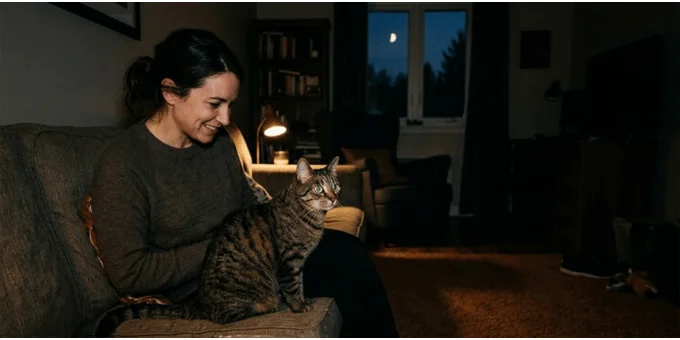
Do cats have night vision? Yes, in the everyday sense, because feline eyes work exceptionally well in dim light. They still cannot see in absolute darkness. Their advantage comes from eye anatomy built to capture and reuse scarce light.
| Key fact | What it means |
|---|---|
| Low-light ability | About six times better than human vision in dim conditions |
| Complete darkness | Vision still requires some available light |
| Main advantage | Rod-rich retinas are highly sensitive to dim light |
| Reflective layer | The tapetum lucidum sends unused light back through the retina |
| Activity pattern | Domestic felines are usually crepuscular |
| Color vision | Blues and yellows are easier to distinguish |
| Eye glow | Reflected light creates the familiar nighttime eyeshine |
Felines cannot see in total darkness, because their eyes still need light. In dim conditions, they can see about six times better than people. Large pupils, light-sensitive rods, and a reflective tapetum lucidum help them use scarce light efficiently, especially around dawn and dusk.
Key takeaways: Low-light vision is strong, but zero-light vision is impossible. Feline eyes favor sensitivity over fine visual detail. Sudden changes in nighttime navigation can justify a veterinary examination.
Do Cats Have Night Vision? The Precise Answer
Veterinary sources describe this as enhanced low-light vision, not true zero-light sight. Merck Veterinary Manual reports roughly six times better dim-light vision than people. PetMD gives a similar estimate of about 5.5 to seven times better.
That difference explains why a hallway can feel dark to you but still be usable for your pet. Moonlight, streetlights, or nearby indoor lighting may provide enough illumination. A sealed room with no incoming light removes that visual advantage.
Why Feline Eyes Work So Well in Dim Light
The retina contains photoreceptor cells called rods and cones. Rods respond strongly at low light levels. Feline retinas contain many rods, helping the eye collect information when illumination becomes scarce.
Another advantage lies behind the retina: the tapetum lucidum. This reflective layer sends unabsorbed light back toward the photoreceptors. This second chance to detect light improves sensitivity without creating new light.
Pupil shape also helps control how much illumination reaches the retina. The pupils become narrow vertical slits under bright conditions. They expand considerably as the environment darkens, letting more available light enter.
A relatively large cornea provides another advantage in low illumination. More incoming light can enter before reaching the retina. These features work together rather than functioning as separate night-vision systems.
What Felines Actually See After Dark
Strong low-light performance does not mean sharper eyesight in every situation. PetMD reports that feline color vision centers mainly around yellows and blues. Fine detail and rich color are less important to this visual system than low-light sensitivity.
Distance vision also differs from human sight. PetMD estimates that felines see clearly at 20 feet what an average person sees clearly at 30 feet. This tradeoff suits an animal that often stalks and pounces at relatively short distances.
Movement is especially useful when illumination drops. A small motion can reveal prey, a toy, or another animal before fine details become clear. That sensitivity helps explain the impressive confidence pets often show in darkened rooms.
Domestic cats are also usually crepuscular rather than strictly nocturnal. Their natural activity often increases around dawn and dusk. Those periods provide exactly the dim lighting their visual system handles well.
Why Cats’ Eyes Glow at Night
The familiar greenish or yellow eyeshine does not mean the eyes produce their own light. Incoming illumination reaches the tapetum lucidum behind the retina and reflects outward. Some reflected light exits through the pupil, creating the glow you can see.
The same process gives retinal photoreceptors another opportunity to capture incoming light. That makes eyeshine a visible side effect of a useful low-light adaptation. A flashlight or camera flash often makes the effect especially easy to notice.
Eyeshine can vary with viewing angle, pigmentation, and the available light source. It may appear green, blue-green, yellow, or another shade. The key point remains the same: reflected external light creates the visible effect.
This feature is useful, but it has clear limits. A reflective surface can only return light that reaches it. Without incoming illumination, the tapetum has nothing to reflect.
Can a Cat See in Complete Darkness?
Even an efficient feline eye can’t create a visual image without incoming light. The tapetum can reflect available illumination, but it cannot generate it. That is why true pitch-black spaces defeat normal vision.
A room that appears black to human eyes may still contain usable light. Outdoor lamps, moonlight, windows, and nearby rooms can create faint illumination. Your pet may therefore see obstacles that are almost invisible to you.
Vision is also only one part of nighttime navigation. Whiskers help detect nearby objects, while hearing provides information about movement and location. Familiarity with the home can further support confident movement through known spaces.
These other senses can make complete darkness seem less limiting than it is. An animal may still locate familiar resources without forming a clear visual image. Don’t mistake that behavior for zero-light eyesight.
Should You Leave a Light on for Your Cat at Night?
Most healthy pets don’t need bright household lighting throughout the night. Normal homes often provide enough ambient light for strong low-light vision. A dim night-light may still help senior animals or pets showing possible vision changes.
Keep food, water, and cat litter in predictable locations whenever eyesight becomes uncertain. Stable routes can reduce confusion when an animal relies more heavily on memory.
A safe home involves more than lighting alone. Household objects and plants can also create risks for curious animals. Mindspaper’s pet-focused guide to snake plant safety provides another example of practical home risk assessment.
For a healthy animal, routine usually matters more than keeping every room brightly illuminated. Avoid repeatedly moving important resources without a reason. Watch how confidently your pet moves when household lighting changes.
When Nighttime Vision Changes Need a Veterinarian
A pet that suddenly struggles in familiar dim spaces may have more than ordinary age-related changes. Cornell recommends watching for navigation problems and visible eye changes. PetMD also advises prompt attention when unusual eye or vision symptoms appear.
Watch for these warning signs.
- Bumping into furniture or becoming disoriented in familiar rooms
- Pupils that remain unusually large or differ noticeably in size
- Cloudiness, redness, discharge, swelling, or repeated squinting
- New reluctance to jump, climb stairs, or enter darker areas
Gradual vision loss can be difficult to notice because animals adapt to familiar surroundings. Sudden blindness requires urgent veterinary attention. Early assessment may protect remaining sight when the underlying cause can be treated.
Night blindness can also appear with specific retinal disorders. Progressive retinal atrophy, for example, may first cause difficulty under dim conditions. A veterinarian can examine the eyes and determine whether behavioral changes reflect an eye problem.
Frequently Asked Questions
Do Cats Have Night Vision in Total Darkness?
No, normal eyes still need incoming light to form a visual image. Felines function extremely well with very little light. True zero-light conditions prevent the retina from receiving the light required for sight.
Are Cats Nocturnal?
They are generally classified as crepuscular rather than strictly nocturnal. Activity naturally tends to increase around dawn and dusk. Individual household routines can still lead to energetic behavior later at night.
Why Do Feline Eyes Shine in Photos?
A camera flash can reflect from the tapetum lucidum behind the retina. Part of that reflected light travels back through the pupil toward the camera. This creates the bright eyeshine commonly seen in nighttime photographs.
What Colors Can Felines See?
Current veterinary guidance describes their color vision as dichromatic. They can distinguish blues and yellows more easily than many other hues. Their world is not simply black and white.
Should I Worry if My Older Pet Becomes Clumsy at Night?
A new change deserves attention, especially when your pet previously moved confidently in dim rooms. Bumping into objects or avoiding stairs can accompany vision loss. Contact your veterinarian when these behaviors appear suddenly or continue.
The Bottom Line
Feline nighttime sight is impressive because the eye uses limited illumination so effectively. Rod-rich retinas, wide pupils, and the tapetum lucidum work together in dim environments. None of those features allow vision when absolutely no light exists.
For owners, the practical lesson is simple. Keep your pet’s environment predictable and watch for sudden changes in nighttime movement. You can also browse Mindspaper’s Lifestyle coverage for more household and pet-related reading.